Tacoma Planning Commission mulls ending parking minimums
Planning Commission formally passed a motion (7-0 with one abstention) to direct staff to consider Option B to develop code for citywide reform to eliminate parking minimums.


Following passage of Senate Bill 5184 (Concerning minimum parking requirements) previously covered on this blog, planning staff at the City of Tacoma met with the Planning Commission late last year to discuss its impacts. They collected questions from commissioners to understand what information would be crucial to them to identify a potential way forward to bring the City into compliance with new provisions in the Growth Management Act by the end of 2026.
On the table were two options for updating the code:
Option A: Update the parking code to comply with state mandates.
Option B: Pursue broader parking reform and removal of minimum parking requirements citywide
A majority of commissioners at the introductory meeting in December 2025 indicated that they would be inclined to pursue Option B, but requested more background information and statistics to support further deliberations.
The information compiled in the agenda packet for the Planning Commission's March 4, 2026 meeting included: benchmarking against other jurisdictions on the issue of parking requirements including interview responses with cities that have removed or are in the process of removing parking requirements, answered questions from Commissioners about the history of parking changes in Tacoma since passage of the Growth Management Act in 1990, and data about the impact of parking requirements to housing affordability and supply. The packet also includes a letter from the Climate and Sustainability Commission advocating for removal of parking requirements in support of walkable communities, climate action, and space for recycling bins for multiunit housing.
Staff report shows a history of reform
Planning and Development Services showed that parking requirements have changed numerous times since 1990 with no fewer than five significant wholesale modifications that have created code options for shared parking, parking reductions, offsets, bonuses and exceptions. Each of these successive waves targeted at reforming the practice of requiring a minimum ratio of parking stalls has added significant complexity to the parking code, applying context-sensitive provisions to Downtown Tacoma, neighborhood and crossroads centers, and most recently with elimination of parking requirements for residential and some ground floor commercial within 1/2 mile of the city's most frequent transit routes on 6th Avenue, S 19th Street, and Pacific Avenue.
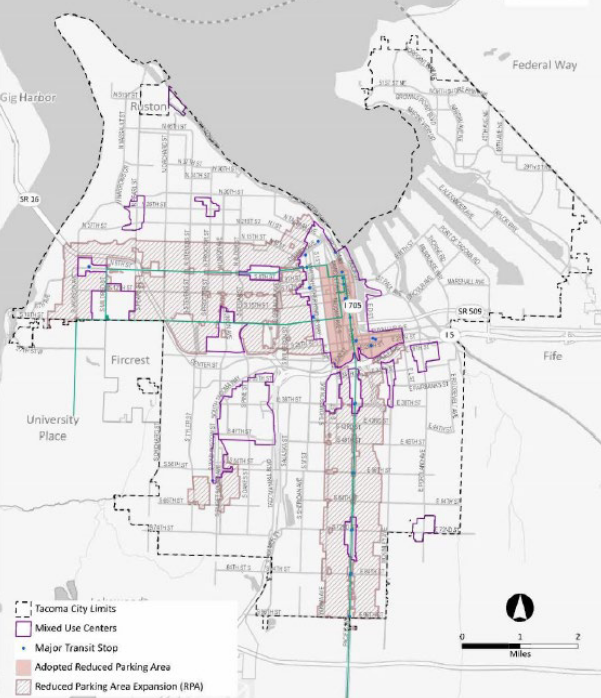
Due to the fragmented nature of these historic changes, different standards, practices and methods of land use means testing that apply to uses across the city – with the quantity of parking varying by numerous factors: use type, base zone, inclusion in a reduced parking overlay, proximity to frequent transit, housing affordability, proximity to core pedestrian streets, preexisting buildings, transit-based and transportation demand reductions, and other unmentioned site features like tree preservation and development of accessory dwelling units.
Impact of parking on housing costs documented
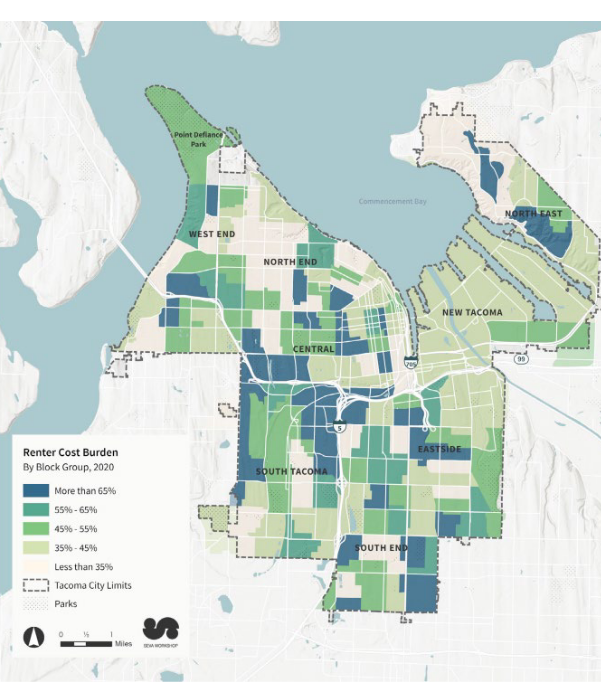
Some of the Commission's questions focused on the direct impact to housing affordability and housing production. Staff returned data on how much of the city is rent burdened and how parking costs during development get passed on to residents. Data from the One Tacoma Comprehensive Plan shows that renters are overburdened by housing costs across the city in all council districts, with the issue distinctly affecting households of color more than others. The impact of parking requirements in excess of market demands, staff said, led to higher housing costs, reduced walkability and longer travel distances, limited land for essential services, and impacts to frequent transit viability.
Parking construction to still be informed by market demand
Tacoma has some substantial experience with eliminated parking requirements for more than a decade, but because of the lack of development of walkable destinations and transportation alternatives like frequent transit and cycling infrastructure supporting all ages and abilities for shorter trip distances, there is a tendency within development that does get built – to include vehicle parking anyway.
From the staff report:
Developers consistently report that, even when minimum parking requirements do not apply, market expectations often drive the provision of parking. In staff experience, developers frequently state that purchasers or tenants expect parking, so it is provided regardless of regulatory requirements. (italics added)
Potential need for some limits where density is an imperative
In the same response regarding market conditions for parking, staff gives an example of the Port of Tacoma Maritime Center, which has no parking requirements in a shoreline area. Such a facility would otherwise hypothetically only require 180 spaces for office and educational uses, but nevertheless was developed with a surface lot with 300 parking spaces. Staff states, "This example shows that even in areas where minimum parking is not required, developers provide significantly more parking than the code would mandate due to market expectations, perceived tenant or buyer demand, or other considerations." (italics added)
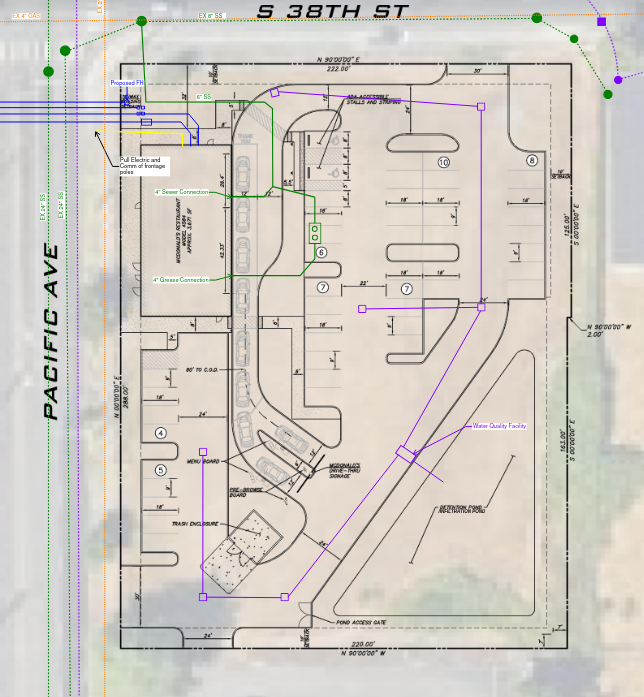
The Port's example mirrors another recently reported development on Pacific Avenue by The News Tribune in the core of the Lower Pacific Crossroads Center on 38th Street for a fast food restaurant with a proposed 3,600 square foot building. Within the center no minimum parking requirement applies and yet the facility plans for a double-lane drive thru and 47 parking spaces. A full half of the site in this instance would be dedicated to excess parking and stormwater runoff mitigation features.
Even if such an establishment were in a standard suburban commercial zone outside of a mixed use center in the city, it would have a current requirement of 6 spaces per 1,000 square feet, or 22 spaces, a difference of 25 spaces between the proposal and that requirement.
SB5184 would mandate that such a city requirement be limited to 2 spaces per 1,000 square feet of building by no later than 2027 or a total of 7 spaces. This creates a yawning gap of 40 spaces between what the market wants to build and State restrictions on parking minimums.
The inclusion of a water detention pond that consumes a substantial portion of the site to address excess stormwater runoff from impervious surface shows how excess parking may not make ecological or urban development sense and may run counter to adopted Comprehensive Plan targets for housing and job density in centers meant to keep Tacoma in compliance with the Growth Management Act.
Commission takes action on Option B
After hearing the presentation given by Stephen Atkinson, Principal Planner at the City of Tacoma, the Planning Commission had a short discussion where most Commissioners described different reasons to pursue citywide parking reform, such as to lower costs for developing affordable housing and to free up land on required but vacant parking lots for walkable infill.
Planning Commission formally passed a motion (7-0 with one abstention) to direct staff to consider Option B to develop code for citywide reform to eliminate parking minimums.
The Commission further clarified that they would like staff to structure a conversation about how to address the needs of parking required by the Americans with Disabilities Act, and whether Tacoma should follow the lead of other cities and not require parking if no parking is built, or to require spaces either on or off street for those users.
Commissioners Dorner (District 2) and Karnes (Public Transportation), also called for consideration of parking maximums in the proposal. Commissioner Dorner suggested that a threshold of 150% of the current parking minimum be used for a city parking maximum and Commissioner Karnes called for limited maximums with application for commercial (but not residential) uses in centers to address the glut of asphalt in commercial and mixed use areas.
Code development and Council next steps
Mayor Ibsen's previous statements, such as in his first State of the City address as well as The Urbanist candidate questionnaire last year, highlighted his positions on the importance of continuing to build upon the efforts of Home in Tacoma to reform local zoning to make housing more affordable for first time buyers and make streets more safe. It is anticipated that the push to remove parking requirements will receive his support when the case is laid out before Council later this year.
Previous to the Commission's meeting a similar presentation was given to the Infrastructure Planning and Sustainability Committee of the Tacoma City Council, where decision makers will first see Planning Commission's recommendation. Several members there indicated that they would be willing to consider a citywide reform effort as a way of improving housing affordability and production and a move to cut down on permitting time during a demonstrated housing crisis.
Staff's proposed schedule includes review of a draft code package by the Commission sometime in April, with a public hearing in May and Planning Commission amendments and recommendation in June 2026. Council consideration would be prior to the January 2027 GMA adoption deadline to facilitate more time to focus on development of the City's budget.
The full staff report on parking requirements is available here: https://cms.tacoma.gov/Planning/Planning%20Commission/PC%20Agendas%202026/PC%20Agenda%20Packet%20(03-04-26).pdf